What an Ice Cream Shop Taught Me About Visual Communication
Working at an ice cream shop, I noticed the flavor wall pairs written names with photographs so customers of all ages, reading levels, and language backgrounds can compare choices and communicate what they want. It made me wonder what classroom walls might look like if written language were paired with photographs, illustrations, gestures, objects, and other meaningful visual supports too.
I work as an Ice Cream Ambassador at Sarah’s Handmade Ice Cream. Although serving ice cream might seem unrelated to my Visual Voices research, I have started to notice connections between the two almost every day.
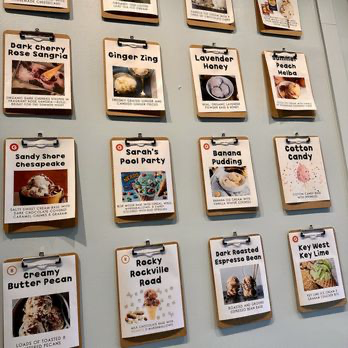
When customers walk into the shop, one of the first things they see is a huge wall displaying all 40 of the daily flavors. Each flavor is identified with its written name and a large photograph of a scoop of that ice cream. Customers can look at the color, texture, mix-ins, and other visual details before deciding what they might want to sample or order.
The wall is colorful and fun, but it also serves an important communication purpose. The photographs help customers understand the choices in front of them, compare different options, make decisions, and communicate what they want. A young child might not be able to read “Sarah’s Pool Party,” but can point to the bright blue scoop. A customer might not know exactly what “Sandy Shores Chesapeake” contains, but the picture provides clues. Even someone who can read every flavor name may find it easier to process 40 choices when the words are paired with images.
Watching customers use the wall has made me think about my own experience learning to read.
In elementary school, the walls of my classrooms were often covered with “sight words” that we were expected to memorize and recognize automatically. The words appeared by themselves, without pictures or other visual cues to help explain their meaning. As a student with dyslexia, I did not experience those displays as helpful. Instead, the words often looked like a mixed-up jumble of letters that I was somehow supposed to recognize and “just know.”
At the ice cream shop, no one assumes that customers should be able to understand dozens of unfamiliar flavor names from text alone. The environment provides another way to access the information. The visual does not replace the written word. It supports it.
That distinction has become increasingly important to my Visual Voices research. How can visual and multimodal communication tools help children understand information, express ideas, participate more fully, and make independent choices? And how can they do that while still supporting, rather than replacing, the skills children need to learn to read?
The flavor wall has made me think about what inclusive communication can look like in a very ordinary setting. Customers have different ages, reading abilities, language backgrounds, preferences, and ways of processing information. Pairing words with images gives people more than one way to understand the choices in front of them.
It has also made me wonder what classroom walls might look like if they were designed with the same attention to access. I do not think the answer is simply putting a picture next to every word. Through my conversations with literacy researchers, I have learned to be more careful about that. Visuals can support understanding, but they should not become a substitute for learning how to read.
I am more interested in the places where visual information can add meaningful context: classroom labels, schedules, choices, directions, diagrams, gestures, objects, or photographs that help children understand what something means or what they are being asked to do.
Working at Sarah’s has made me notice how much the way information is presented can affect who can understand it, participate, and make a choice. Sometimes something as ordinary as an ice cream menu can make me see my research question differently.
By the way, if you stop by, my current favorite flavor is Mango Sticky Rice.