Field Notes from Denmark: What a Forest Kindergarten Taught Me About Communication
A visit to a forest kindergarten outside Copenhagen challenged my assumptions about visual supports — and showed me how communication can be built into the environment itself.
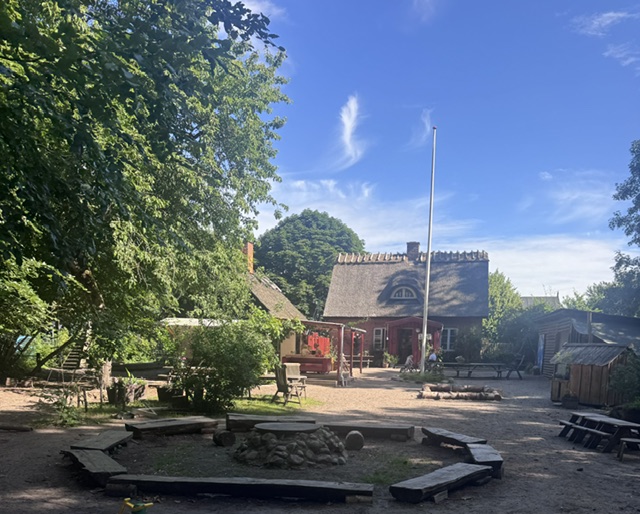
One of the most memorable experiences of my Visual Voices research was visiting a forest kindergarten just outside Copenhagen. Before I arrived, I expected outdoor learning to be an important part of the day. What I did not expect was how completely the environment itself would shape the way children learned and communicated.
Instead of relying on a traditional classroom filled with instructional materials, the forest itself became the learning environment. Logs became balance beams, sticks became writing tools, and trails became places to solve problems, ask questions, and work together. Rather than directing every activity, the teachers observed carefully, stepped in when needed, and gave children space to take ownership of what they were doing.
I was especially interested in the mixed-age group. Children from ages three to six spent the day together, and I watched older children help younger ones navigate trails, join activities, and solve problems. Younger children watched, imitated, and learned from the children around them. Conversation mattered, but so did observation, gesture, movement, facial expression, and shared experience.
I was also struck by the amount of independence children were given. Children climbed trees, explored uneven terrain, and used real tools with supervision. Risk was not removed from the environment. It was managed. In this setting, those experiences seemed to give children opportunities to practice independence, confidence, and judgment.
As someone researching visual communication, I also noticed something that challenged my expectations. There were fewer conventional classroom visuals than I often see in schools: fewer labels, picture schedules, posters, or printed cues. Yet visual learning was everywhere. Teachers demonstrated instead of only explaining. Children watched and copied one another, followed maps and trails, read cues from the environment, and used gesture and movement to communicate. The forest itself provided information about where to go, what to do, and how to participate.
That observation complicated the way I had been thinking about visual supports. When I began Visual Voices, I often thought about visuals as things that educators add to a classroom: symbols, schedules, photographs, diagrams, or labels. This visit made me think more broadly. Visual communication can also be built into how something is demonstrated, how a routine is modeled, how children learn from one another, and how the environment itself can communicate information.
The visit also made me think about the relationship between independence and communication. Because children were given space to explore and solve problems together, they had to pay close attention to one another. They learned not only by listening to adults, but by watching peers, noticing what was happening around them, and figuring out how to join in.
My research is not about deciding that one educational approach is better than another. It is about noticing what different settings reveal about the ways children learn and communicate. This forest kindergarten showed me that visual communication does not always look like a picture on a wall or a symbol on a schedule. Sometimes it is a demonstration, a gesture, a map, a movement, or a cue in the environment that helps a child understand what is happening and how to participate.
Since that visit, I have kept wondering: How can teachers design environments that help children understand, participate, and communicate without always needing to explain everything with words?